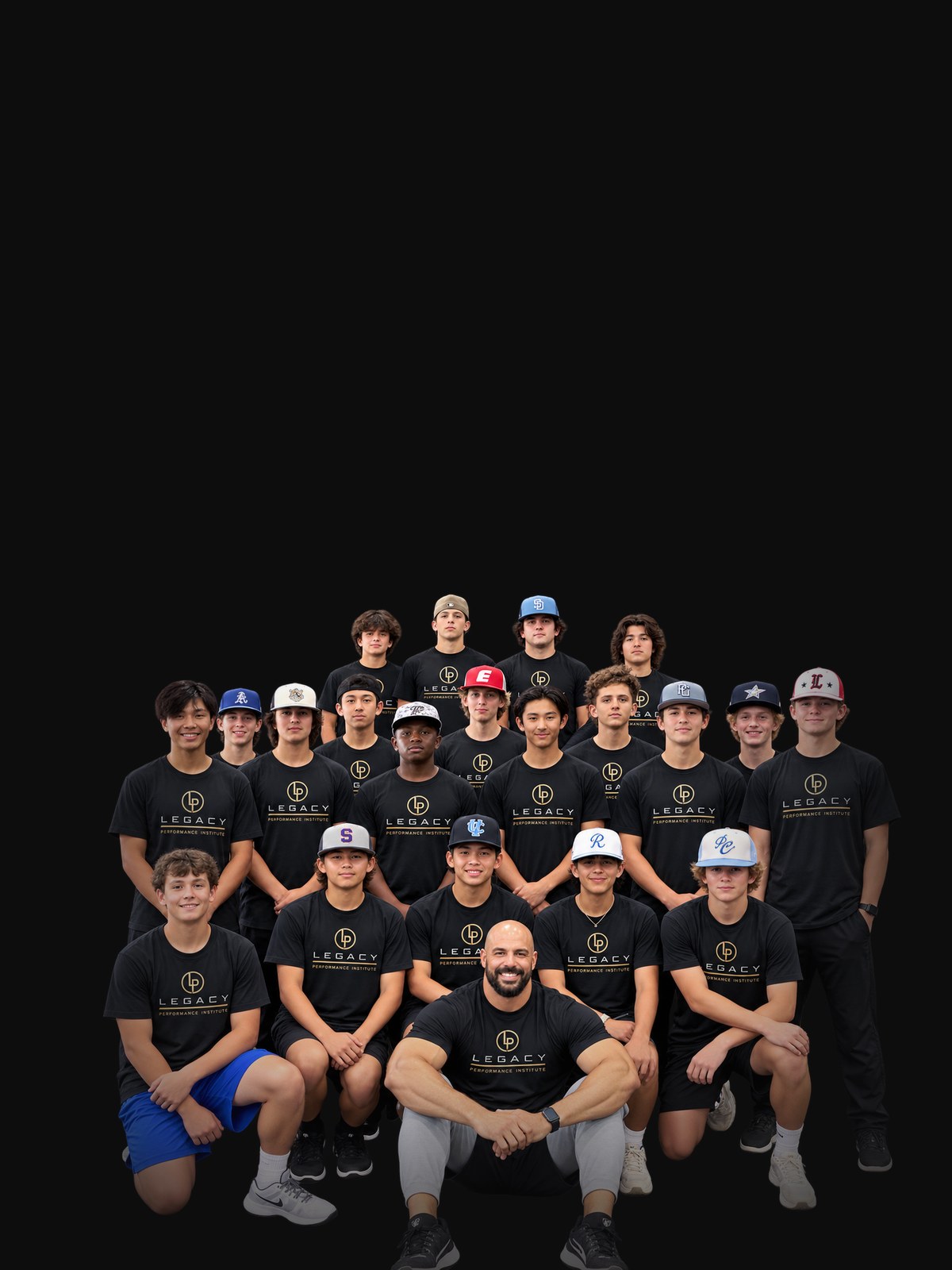
Small Group Training Programs in San Diego: Build Strength Together at Legacy
Six months of 6 a.m. HIIT classes, three times a week, and your body composition hasn’t moved.
Most boot camp programs follow the same template. Choose a collection of hard exercises, randomize the order, push everyone to their limit, repeat. The result is genuine soreness, substantial sweat, and a vague sense that something productive is happening — until eight weeks pass and the body composition numbers have not moved, strength has not increased, and the only measurable adaptation is a higher tolerance for discomfort.
That model fails because effort alone does not produce results. Structured, progressive effort does.
Legacy Performance Institute’s boot camp training program in San Diego is built on a fundamentally different framework — one borrowed from how competitive athletes are actually periodized. Three distinct phases. Progressive overload across every session. Coach-to-athlete ratios that allow real-time form correction. And a group environment engineered to amplify individual output without sacrificing the coaching quality that makes the effort productive in the first place. Here is the exact breakdown of how the Legacy boot camp program is built and what results look like at week 4, 8, and 12.
The defining characteristic of a well-designed boot camp program is periodization — the deliberate sequencing of training stress across time to drive specific physiological adaptations. The National Strength and Conditioning Association defines this as planned variation in training volume, intensity, and exercise selection to produce continued progress while managing cumulative fatigue. The key word in that definition is planned.
Random variation is the opposite of periodization. When workouts are shuffled weekly to maintain novelty, the neuromuscular system never accumulates enough repeated exposure to a movement pattern to get meaningfully stronger at it. Body composition changes stall. Joints absorb repetitive stress from non-progressive loading without the tissue adaptation that comes from structured progression. Participants plateau within 6–8 weeks and frequently mistake the plateau for their ceiling — when it is actually a programming failure, not a physiological one.
The hallmarks of a periodized boot camp worth doing:
These are the standards the Legacy boot camp program is held to. They are also the standards you should use to evaluate any group fitness program before committing 12 weeks of time and energy to it.
The program runs 12 weeks, three sessions per week, approximately 55–60 minutes per session. Each session follows the same structural architecture: a 10-minute dynamic warm-up, a primary strength block, a conditioning block, and a 5-minute cooldown with targeted mobility work. The variation happens inside those blocks — not to the structure itself. Consistency of structure is what allows measurable progression.
The goal of Phase 1 is not maximum exhaustion — it is movement competency, baseline conditioning, and joint preparation so the higher-intensity work in Phases 2 and 3 can be executed safely and with full range of motion. Athletes who rush Phase 1 loading consistently accumulate compensatory overuse issues by week 6 or 7 that derail the entire program arc.
Primary strength block (two to three of the following patterns per session, rotating across the week):
Conditioning block: Continuous work circuits maintained at 70–75% of estimated maximum heart rate. Format is 40 seconds of work with a 20-second transition between stations, four to five stations, three rounds total. Stations include sled push at body weight load, med ball slam, weighted step-up, kettlebell swing, and battle rope alternating waves. Rest between rounds is 90 seconds.
Results by week 4: Most participants report measurably improved movement quality on primary patterns, body composition changes beginning to appear (typically 2–4% reduction in body fat for participants training consistently and maintaining a modest caloric deficit), resting heart rate dropping 3–5 bpm from baseline, and noticeably shorter recovery time between conditioning sets compared to week one.
Phase 2 shifts the primary adaptation target from movement competency to strength development. Loads increase, rep ranges drop, and the conditioning block transitions from steady-state circuits to higher-intensity interval formats. The body built a foundation in Phase 1 that can now tolerate — and respond to — heavier loading.
Primary strength block:
Conditioning block: EMOM (every minute on the minute) and Tabata formats replace the continuous Phase 1 circuits. Work-to-rest ratios compress to 1:1, pushing working heart rate into the 75–85% range. Protocols include battle rope intervals (20 seconds maximum effort, 10 seconds rest × 8 rounds), sled sprint intervals (10-meter effort, walk back is the rest period × 4 rounds), and complex sets pairing a loaded carry with a push-up or squat variation.
Results by week 8: Primary lift loads typically increase 15–25% from Phase 1 baselines. Body fat reduction averages 5–8% from program start for participants maintaining consistent attendance and reasonable nutritional habits. Conditioning markers — specifically how quickly heart rate recovers to below 130 bpm after a maximal interval — show measurable improvement compared to week 1 and week 4 assessments.
Phase 3 integrates power — the ability to express strength quickly — while driving the conditioning adaptation to the highest point in the program arc. This phase produces the most visible body composition results because the metabolic demand is at its peak and the strength base from Phase 2 allows heavier absolute loads in all primary movements.
Primary strength and power block:
Conditioning block: Peak interval formats. Assault bike or rower at 20-second maximum effort followed by 40 seconds of rest for 8–10 rounds. Sled push complexes: 20 meters at body weight plus 25%, 30 seconds rest, 4 rounds. Complex sets combining a primary strength movement with a loaded carry — trap bar deadlift × 3 reps immediately into 30-meter farmer carry, 90 seconds rest, 3 rounds.
Results by week 12 for participants completing three sessions per week with consistent nutritional habits: 8–12% body fat reduction from baseline, 20–30% strength increase on trap bar deadlift and primary push and pull patterns, measurable improvement in conditioning benchmarks including heart rate recovery rate and timed carry capacity, and significantly improved movement quality scores compared to the week one intake assessment. These are averages based on typical program completion — individual results vary based on starting point, nutrition adherence, sleep quality, and outside activity volume.
There is a well-documented phenomenon in exercise science called social facilitation: the presence of others performing the same task measurably increases individual effort and output. Research published in the Journal of Sport and Exercise Psychology found that participants training alongside others worked at approximately 15–20% higher intensities on comparable efforts compared to those training alone. The effect is not motivational folklore — it is a physiological response to the social environment.
This is a real structural advantage of a well-designed group training program, and it is one of the primary reasons a boot camp athlete will often outpace progress made during solo gym sessions of equal or greater time investment. But the advantage only holds under two conditions: the group environment needs structure so athletes are not competing for the same load, and coaches need to be actively managing both effort and technique — not merely cueing the next exercise.
Legacy maintains a coach-to-athlete ratio of 1:8 or better in every boot camp session. That is the functional ceiling below which real-time coaching remains possible. Above that ratio, a coach becomes a program host — calling out exercises and managing the clock rather than actually coaching individual movement. The group energy amplifies your effort. The coaching ensures that effort is directed into productive adaptation rather than accumulated compensatory stress that surfaces as an injury in week seven.
This structure also integrates cleanly with other training you may already be doing. Athletes currently in our runners program find that the boot camp strength blocks develop exactly the posterior chain strength and lateral hip stability that running training alone will not produce. The two programs reinforce each other rather than competing for recovery resources when weekly volume is sequenced correctly — coaches will advise on that sequencing during intake.
For a deeper look at how the conditioning component specifically adapts across the 12-week program arc, the breakdown of metabolic conditioning training in San Diego covers the energy system science behind the interval formats used in Phases 2 and 3 and why work-to-rest ratios matter as much as the exercises themselves.
The boot camp program is the right starting point if you have a baseline of general fitness — meaning you can complete 20 continuous minutes of moderate-intensity activity and have done some form of resistance training in the past 12 months. It is also the right environment if you respond well to external accountability structures: group settings, coaches who track your progress by name, and the social commitment of showing up on a defined schedule. And it is the right program if your primary goals are body composition improvement, conditioning development, and foundational strength — not a highly specific athletic performance outcome or post-surgical rehabilitation.
The boot camp program is not the right entry point if you are returning from a significant injury or surgery within the past six months — Phase 2 and 3 volume and intensity will outpace safe tissue reloading. It is also not the right starting point if you have never done structured resistance training and your movement screen reveals meaningful pattern deficits. In those cases, a short personal training bridge — typically four to six sessions — will produce substantially better boot camp outcomes than entering Phase 1 with movement compensations that get loaded heavier each week.
For desk workers and sedentary professionals who want the group training environment but are newer to structured fitness, our personal training program for desk workers addresses the postural imbalances — hip flexor shortening, thoracic restriction, anterior pelvic tilt — that make Phase 1 boot camp loading less effective and less comfortable. Three to four weeks of targeted corrective work before entering the group program meaningfully improves both safety and results across the full 12-week arc.
The boot camp program also pairs well with the functional fitness program for participants who want both structured group intensity and movement-quality focused individual coaching in the same training week. Coaches will advise on weekly sequencing to ensure the combined volume stays within productive recovery capacity.
Before your first group session, you complete a 45-minute intake assessment. This is not a sales conversation — it is the functional movement screen and fitness baseline that determines how the program is individually scaled from day one.
The assessment covers five areas:
That intake data informs every session that follows. When a coach cues a load that is challenging at an 8 out of 10 effort, they already have your baseline numbers and know what that means for you specifically. The group program scales to the individual because the individual is assessed before the group work begins.
Your first session in the group will feel unfamiliar — the pacing is faster than a solo gym session, the energy is different, and Phase 1 loads will feel lighter than you expect. That is deliberate. Coaches load conservatively in the first two weeks to ensure movement quality is established before intensity increases. Athletes who self-select heavier loads in week one because the prescribed load feels easy consistently pay for that decision in weeks three and four when the volume increases and the movement patterns need to be clean under fatigue.
Boot camp sessions run on a set weekly schedule with limited spots per class to protect the 1:8 coaching ratio. New participants begin with the intake assessment, which is typically schedulable within 48–72 hours of initial contact.
The program runs in 12-week cycles. New participants enter at the start of a cycle — mid-cycle entry is not offered, because Phase 1 competency work cannot be skipped without compromising Phase 2 loading safety and outcomes. If you reach out between cycles, coaches will schedule your intake and confirm your Phase 1 start date for the next cohort.
If you are uncertain whether the boot camp program or a different format is the right match — individual personal training, the functional fitness program, or a hybrid approach combining both — the intake conversation is where that question gets answered. Coaches will tell you honestly if a different program is a better starting point given where you are right now. The goal is that you get the results you came for. The program vehicle matters less than placing you in the one that gets you there.
Contact Legacy Performance Institute San Diego to schedule your intake assessment and confirm your start date for the next boot camp cycle.
This is general fitness information, not medical advice. Check with your physician before starting a new exercise or nutrition program, especially if you have a medical condition, an injury, or are pregnant.
Coaches whose specialties include strength and conditioning and group fitness.
Six months of 6 a.m. HIIT classes, three times a week, and your body composition hasn’t moved.
David was a 42-year-old attorney who had been going to the gym consistently for three years. He could bench press 225 lbs, finish a half marathon, and looked the part.
A client walked into our San Diego facility in January having tracked the same 1,800-calorie, 150g-protein target for four straight months. Her lifts hadn’t moved in six weeks.
Your first consultation and introductory session with a Legacy coach is free, with no obligation. A Legacy coach will build the plan around your history, schedule and goals.